Monday, April 16, 2012

The Game of Faro


Faro Card Table c. 1910 - THM Collection
Favored because the odds of winning were greater than any other gambling game, Faro was played in almost every gambling hall in the Old West. Its easy to learn rules, fast action play and gainful odds against the house gave it popularity among the gambling masses. In 1882, a New York Police Gazette study estimated more money was wagered on Faro in the U.S. each year than on all other forms of gambling combined.

Surviving its forbidden play in France during the reign of Louis the XIV, the late 17th century French gambling card game came to the U.S. in the 19th century. It infiltrated the Old West saloons with vigor and this game of chance soon became a dangerous scam.

The game was played with one deck of 52 cards and as many players, "punters", that could fit around the Faro table. Unlike most games in the gambling hall, faro was not owned by the saloon proprietor but instead by the faro dealer. He owned the table, cards, all the faro equipment, and put his own investment down to cover the bets of the game. One of the most famous faro dealers to set up in the west was Wyatt Earp who dealt faro in Tombstone when he first arrived.


To play the game, gamblers placed bets on the thirteen card Faro table layout. Flat bets, split bets, copper bets, high card bets -- all betting on the winning card or the loser. The dealer then draws two cards from the "Faro Box." The first card drawn, the bankers card, was the loser and the second was declared the winning card. So, if you had placed your chip on the Ace, and the Ace was the winning card you received a matching payout.

Faro Case Keep c.1910
THM collection
The Faro Box and Case Keep were employed to ensure gamblers fair play. However, since the equipment was owned by an entrepreneur, it soon became a false sense of  security. The gaffing of a Faro Box was so prevalent that rigged boxes were openly sold by catalog companies.
The final bet, when there are only three cards left in the deck, is known as a “Calling Turn.” It was the most popular and exciting point in the game. Players bet on what card would be dealt as the loosing card, the winning card, and the “Hock,” the last card which is not used. If you hit this bet, it paid four to one.


If you want to take your chance and belly up to the Faro table, follow this link for an online version:

http://www.gleeson.us/faro/game


~ Cameo Hoyle
Telluride Historical Museum
Exhibits Manager
http://www.telluridemuseum.org/

Thursday, February 23, 2012

Quilting Decoded

Last week we celebrated the opening of our newest temporary exhibit, Harvest of Heritage. The touring exhibit created by the Museum of Western Colorado, funded by the National Endowment for the Arts American Masterpieces Program and presented by Colorado Creative Industries, displays artists works linked to Colorado’s rich agricultural heritage. Artists chosen for inclusion in this exhibit have met the highest standards of the Colorado Creative Industries’ Cultural Heritage Program. Many have been awarded state grants and fellowships to help them preserve, present, pass on and celebrate their traditional art form. Two have received the National Endowment for the Arts’ highest honor for our nation’s tradition bearers. Many have served as master artists who have passed on skills and knowledge to a next generation of apprentices. Their stories bring our state’s history and geography to life.

The museum has contributed a few of its own artifacts to the exhibit while it is being housed there for six weeks. The artifacts celebrate Telluride's heritage through traditional art form, and just like the others displayed; they too have a story to tell.

The cotton gold and cream double hourglass patterned traditional quilt had been authenticated by the Colorado Quilting Council in 2005 as a historic quilt. The general knowledge of its construction and fabric content were noted. Beyond that however, the museum currently has no information on its origination. Admittedly I was interested in it mainly because it matched the yellow color theme of the exhibit, but also its intricate hand stitching and simple design has impact. It seemed special, magical. In honor of the Harvest of Heritage exhibit and having heard that every quilt pieces together a story, I felt compelled to research the story of our quilt's pattern.

Most quilting bees were social gatherings of women helping a friend or neighbor finish a quilt, and more often helping a bride-to-be finish her quilts before she married. Women could share family news, exchange recipes, and give child-rearing tips. Quilting was a social asset, and next to church, going to quilting bees was the primary contact for women.

It is speculated the hourglass quilt pattern was originally developed as “quilt code” by the Sealcott Indians to help fugitive slaves escape north to freedom. These coded quilts would have hung outside windows or on fences advising escaped slaves when and where it was safe to travel. The color of the hourglass indicated what time of day help would come: red for morning, yellow or green for afternoon and blue or black for evening.[1]

"Quilt code" is a highly debated subject, with many theories on the code's existence, or non existence. Myth or fact, the idea of quilt code empowers and adds mystery to the unknown story of our own traditional gold and cream double hourglass patterned quilt.
~
Cameo Hoyle
Exhbits Manager
Telluride Historical Museum
http://www.telluridemuseum.org/


Referenced:
[1]  http://ugrrquilt.hartcottagequilts.com//

Wednesday, December 21, 2011

Smile for the Camera

The snapping of the camera shutter is all too familiar during the holiday season as families in their Sunday best cheerfully pose for portraits and children “cheeeeeezzz” for Grandma unwillingly.

Historically, portraiture was reserved for aristocracy, painted on canvas, and documented the sitter’s nobility. Ordinary middle class peoples looked upon portraiture as an extravagant expression of superiority. As democracy rose and middle class demanded bourgeois luxuries, artists responded with miniature portraits and silhouettes. However, those archetypal substitutions could not survive the invention of the Daguerreotype in the mid 19th century. The Daguerreotype (the first successful commercial photographic process) made portraiture affordable, although at first only afforded by the well-to-do.

Today, photographs capture sentimental moments like fleeting memories, but photography wasn’t always so candid.  Before the camera became a commodity and Uncle Joe could snap the family portrait in half a second, having your photograph made was luxury and privilege. The photographer’s studio was a fixed business establishment and a scheduled appointment was a must. However, the realization of cameras with built in processing freed the photographer from his studio by mid 19th century.

Portraits then came in all sizes, from small pocket sized to lockets and mantle wedding portraits. Street photographers solicited on boardwalks by the beach, cameras were toted to picnics, and even the Civil War. Portrait enthusiasm also developed into sentimental jewelry with the invention of the photo button camera in 1910.

A curious type of photo found in our collections is not a wearable button, but instead a six inch button plaque stamped Chicago Portrait Company on the back. Founded in Chicago about 1893, this innovative portrait company took full advantage of street photography. They sent out photographers (really salesmen then called “drummers”) to travel the country and take portrait photos. The film was then mailed to headquarters, printed, mounted and mailed back to the customer.

The button plaque was a popular alternative to the traditional framed portrait. Not only was it small and portable (important for a booming mining town where space was a disappearing commodity), but it was also affordable because of its tintype photo process, the faster cheaper way to produce a print.

We haven’t identified the woman in the portrait, but can trace the artifact to the McPhee estate in Telluride. Their lineage is a mystery other than John McPhee who published a local newspaper covering Norwood, Nuclea, and Telluride news.


~ Cameo Hoyle
Exhibits Manager
Telluride Historical Museum
www.telluridemuseum.org

Wednesday, September 14, 2011

Velocipede for Two

In 1894, while working at a small bike shop in New Castle, Indiana, Charles Teetor built a fine bike for his wife. Soon after, the Division Superintendent of the Chicago and NW Railroad, Charles Hartley (also cousin of Mrs. Teetor), saw the bike. "Build me a bike that will ride the rails!" Hartley requested.

You see, the only way Mr. Hartley's inspectors could perform their rail inspecting jobs was by walking the tracks or firing up a locomotive, neither very efficient. At the height of the industrial revolution however, efficiency could not be thrown under the train. A year later the Railway Cycle Manufacturing Company was founded in Hagerstown, Indiana by the Teetor brothers.

The cycle debuted with much debate. Inspectors were sure biking the railroad would be a hassle. It would be too much work to pedal the bike and just plain inconvenient. However, almost immediately after its debut, the lightweight quad cycle was adopted by railways across the nation and also the mines.

With underground tunnels spanning miles, mine staff covered large distances on foot (or perhaps if lucky, catch a passing ore train) to reach different designated working areas within the tunnels. In Telluride, these distances could sometimes be more than five miles and increase in elevation by 1600 feet. That's a lot of beat for a shift boss.

The rail mounted cycle began use in the Telluride region around the early 1900's, but was abandoned in the 1930's. Some thirty years later, the Idarado Mine Superintendent, Dick Swerdfeger, revived the use of a mine bike after walking a visiting geologist through miles of the Idarado Mine. He knew of the quadcycle from early mine drawings, but hadn't known he could order the fantastic invention until the visiting geologist made the connection for him. He put Dick Swerdfeger in touch with the V-Plex Clutch Corporation, the successor to the Railway Cycle Manufacturing Company and makers of the Teetor Light Inspection Car. Mr Swerdfeger ordered one.


1919 Teetor Light Inspection Car

A mine bike hadn't been used in the local mines since the depression era, and with industrial improvements on diesel powered mining locomotives, the mining crew was greatly amused by the prospects of running over the Superintendent on his "quadcycle." Determined to prove the crew wrong, Swerdfeger took off on a mine bike pilot test a few minutes ahead of the first morning crew train. Two miles later he arrived at his first stop, the main service raise location. The train arrived ten minutes later with a surprised, and maybe somewhat disappointed crew, saddened because they didn't have the opportunity to give the Superintendent a good bump on the bike tail.

Our 1919 Teetor Light Inspection Car now exhibited in the museum was rescued from the Atlas Mine dump above the Ajax mine and donated to us in 1970. Ten thousand rail bikes were still in service in 1971. They often transported more than one mine employee by piling as many as the peddler could withstand on the back platform.

FUN FACT: Despite an accident that left him blind at the age of five, Charles Teetor's nephew, Ralph Teetor, became a brilliant automobile engineer and invented the speedostat (more commonly known as cruise control). What year did cruise control debut? 1958 on the Chrysler Imperial.

~ Cameo
Exhibit Manager
Telluride Historical Museum

Tuesday, August 9, 2011

What the heck is it?!

It's a bird! It's a plane! It's a Crosley Dynacone! And in 1929, you could have one for $25.00. It was the choice for radio lovers in every modern American household of the period. One could say it was a must have radio accessory, known for its sound reproduction and affordability.

On August 31, 1920, the first known news radio program was broadcast in Detroit, Michigan. At the same time, Powel Crosley founded the company that pioneered radio broadcasting. The story goes, Mr. Crosley wanted to buy his son a radio for his birthday but the steep price of $130 dollars was unacceptable. Crosley decided to build his own radio for cheaper and when his finished radio only cost him $35 to build, he was inspired to build for the masses. The first mass manufactured radio, the Harko, sold for $9 and became so wildly popular that Powel Crosley became known as the "Henry Ford of Radio." In 1927 Crosley Radio was the number one radio manufacturer in the world.

 During the mid 1920s the Crosley Dynacone amplifying speaker revolutionized the way was radio heard. Radio static was a listener nightmare before the introduction of FM radio in 1933 and manufacturers were constantly challenged to provide clean, clear sound.  Crosley once again rose to the challenge and produced an affordable, all American product for every household. Connected to a Crosley Showbox radio receiver, the Dynacone's field magnet technology reduced the static sound of AM radio producing dynamic tone and volume.  It not only had enough sound to fill a dance hall but also captivated radio hour listeners. It's not hard to imagine our Crosley enthralling an audience at the Busy Corner Drug Store or even whispering a tune at the Pekkarine Mercantile.

Like HDTV and plasma picture to today's television viewer, the Crosely Dynacone was an innovation that gave your everyday Joe unsurpassed listening pleasure.

Tuesday, June 14, 2011

LAYIN' DOWN THE LAW
TELLURIDE LAWMEN, OUTLAWS, and CRIMES

On June 2nd, the Telluride Historical Museum greeted the summer with our new exhibit "Layin' Down the Law: Telluride Lawmen, Outlaws, and Crimes." With three years in the making, there was much to celebrate. Artist Rick Unger and musical performer Fred Hargrove worked in collaboration to honor an admired and well remembered sheriff from Telluride's history, San Miguel County Sheriff Guy Warrick. Mr. Unger unveiled his colorful portrait of "Sheriff Guy Warrick, Somewhere in Telluride Time, " for the first time to a host of guests and museum staff. Fred Hargrove wrote "The Ballad of Guy Warrick," which also made it's debut at the exhibit opening. The event packed evening continued on with a Squidshow Theater giving it's captivated audience a show stopping performance of “Cops, Crimes, and Criminals.” Everyone is still talking about it.


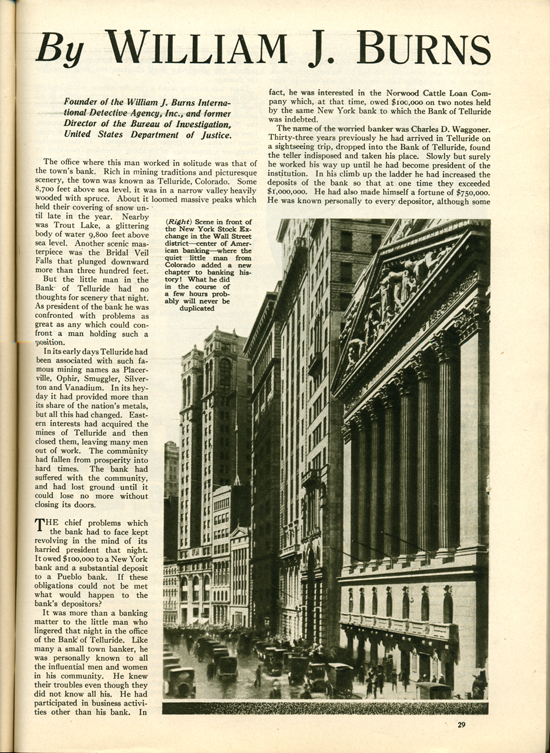
The exhibit not only focused on Telluride lawmen and notorious outlaws, but also their outrageous crimes that often gained national attention. The infamous Butch Cassidy pulled his first bank robbery in Telluride, but he wasn’t the only one who looted the banks. Charles D. Waggoner, Bank of Telluride President in 1929, swindled $500,000.00 from the big New York banks to pay off BOT debts in a time of economic downturn. Accounts of his “Robin Hood” crime could be found on front page newspapers throughout the nation.

However, the newspapers withheld all the juicy details that citizens of the time were craving. Debuting on the newsstands in 1924, non-fiction true crime magazines became a popular alternative to newspapers. These magazines gave detailed retellings of murders, swindles and mysterious cases that the papers would not reveal. 

Many early issues of crime magazines are now rare and difficult to find. However, with diligent research we were able to locate and bring into our collection four true crime magazines, all of which highlight some of Telluride’s most notable crimes. Seeing all the museum supporters greatly enjoy the entertainment and new exhibit is delightful, but the excitement of acquiring new artifacts to our collections is, well… exciting! They were a rare find indeed! 

The April 1931 issue of True Detective Magazine features the gripping story of how C.D. Waggoner deceived Wall Street. It is now on display in the "Layin' Down the Law" exhibit with the three additional true crime magazines we recently acquired.


Until next time, blaze a trail... just don't shoot anybody.


Cameo
Telluride Historical Museum
Exhibits Manager
http://www.telluridemuseum.org/


Listen to the Ballad of Guy Warrick
Written and performed by Fred Hargrove

Get this widget |Track details |eSnips Social DNA


EXTRA! EXTRA! READ ALL ABOUT IT!
Can't get enough? The Telluride Historical Museum blog can now be read on your smart phone! Scan the QR below to follow our blog no matter where you are!
QR code of mobile preview of your blog

Friday, April 8, 2011

Saddle Up!

First invented in the 1380's as a means to protect the virginity of aristocratic girls while riding, the primitive sidesaddle was chair like with a padded seat and a crude plank stirrup large enough for two feet. By the turn of the century, riding sidesaddle became a social expectation, an expression of women's modesty. However, the streets were not crowded with side saddling women, as most women couldn't afford a horse of their own. Besides, what woman would want to soil their dress or evening gown riding open when one could sit comfortably in a carriage? None the less, women who did ride often had special clothing for the occasion.

How does a woman sit on sidesaddle, anyway?
After being hoisted on the saddle by two men, the rider's right leg hugs the top (fixed) pommel, which supports her thigh and the leg then rests along the shoulder of the horse. The lower pommel, or the leaping horn, curves over the top of the rider's left thigh. The leaping horn pivots slightly to adjust to the rider. There is a single stirrup for the left foot. The lower pommel, which gives women more security and movement, was a revolution to the sidesaddle added in the 1830's. This simple addition allowed women to stay on when the horse was in gallop, or jumping. Women then began to take up sporting such as fox hunting and competition.

Our side saddle dates to 1880's and was originally used by Margaret McKenna at the McKenna Ranch in Cedar, Colorado near Disappointment Valley. While Mrs. Eva Daniels, a school teacher, lodged at the McKenna Ranch, she rode the side saddle to the San Miguel Schoolhouse approximately thirty miles to teach.
It is a western style sidesaddle determined by it's square double skirting and fleece lined underside. The flat seat also gives away it's western origin, and allows for the rider to have more freedom of movement. Something a woman needs on a working ranch, or long rides.

When did the sidesaddle go out of style?
The single biggest movement that extinguished sidesaddle usage was Women's Suffrage. Mobility was synonymous with escaping a male dominated society. Women desired to escape the social institution that classified women as a lesser gender. Suffragettes rode into the voting booths on sidesaddle then rode out astride to attest their independance. So saddle up, ladies! Declare your independance and ride both sides of life, or celebrate your unique elegance and sidesaddle it with style!

Famous Women who rode sidesaddle:
Catherine de Medici
Marie Antoinette
Queen Elizabeth II
Catherine the Great (until she had a portrait painted of her riding aside wearing a male officers uniform!)

This photo came to me from the Wilson family. That's Goldie sporting the side saddle and her owner Gladys Wilson enjoying a sunny Telluride afternoon.


~ Cameo
Exhibit Manager
Telluride Historical Museum
http://www.telluridemuseum.org/