Monday, January 18, 2016

Did Telluride Have the First Electric Street Lights in the World?


Like many small towns, Telluride claims an impressive-sounding ‘historical first.’ Our particular claim is that Telluride became the site of the world’s first long distance transmission of alternating current for commercial purposes in 1891. The other claim that gets bandied about is that Telluride was the first town in the world to have electric street lights. This record contrasts with the first in its utter lack of qualifiers. Unlike ‘first long distance transmission of alternating current for commercial purposes,’ which looks unwieldy and underwhelming on a signpost, ‘first electric street lights in the world’ is succinct and impressive. It is also almost certainly untrue. The city of Wabash, Indiana claims to be: “the first town in the world to be generally lighted by electricity” as of March 8, 1880 (Tocco 350), more than a decade before Telluride makes its own dubious claim. But there is a basic problem with historical firsts of this nature. What exactly does “generally lighted” mean as opposed to just “lighted?” If a private party had paid for the streetlights instead of the town would it still count? Was every street lit? Every alley? With historical records like these, there is no governing body unless Guinness deigns to intervene. Wabash is not the first town in the world to have electric street lights, though it may have been the first town to be “generally lighted by electricity.” It seems like Paris, true to its nickname, may have that honor, but once again, this is very difficult to substantiate because there are so many different concurrent experiments, exhibitions, and installations, that it is probably misleading to think about a single origin of electric lighting in the first place. ‘First long distance transmission of alternating current for commercial purposes,’ on the other hand, does have some historical value that belies the string of qualifications.
For about a hundred years, electromagnetism was a promising novelty, the object of tinkering by renaissance men, backyard inventors, and soon-to-be-disappointed entrepreneurs. Ben Franklin conducted his famous kite experiment in 1752. Fifty years later, Sir Humphry Davy was able to create an ephemeral and impractical incandescent lamp with a platinum filament. He also created an arc lamp using two pieces of charcoal for carbon contacts (Slingo et al. 649). The real bottleneck, as it turns out, was not the means of generating light via electricity, but the means of generating electricity in the first place. More than a hundred years after Ben Franklin's discovery, the dynamo was invented, and electricity went from a promising curiosity to the technology that transformed the world.
 Sir Humphry Davy
The first practical sources of electric light were arc lamps, in which light is created by a sustained spark jumping between two carbon contact points. This technology is still in use today in the form of some welding torches. As one might imagine, they give off unpleasant bright, harsh light, making them unsuitable for many of the applications for which we use electric lights today. For this reason, the very first practical implementations of electric light were in lighthouses, where brightness is paramount. Experiments in electric lighthouses were conducted as early as 1839, and in 1862, the first permanent commercial electric light was installed in the Dungeness Lighthouse in Kent (Douglas 136). This installation was as much a novelty as a practical measure, and the financial specifics were followed closely in scientific and trade journals, along with much speculation about the eventual utility and cost effectiveness of electric light. It wasn’t until the early 1870s that electric lighting began to see broader commercial success. The invention of relatively small electric generators such as the Gramme Machine allowed localized energy production that alleviated the need for large amounts of copper wire. The arc lamps did not give off a pleasant or calming light, but they did give off a lot of it, and for this reason, once they became economically viable, electric lights were installed in factories and the like, where the potentially greater cost of electricity versus oil or gas was offset by fewer injuries, fewer mislaid tools and parts, and the other benefits of this harsh lighting.
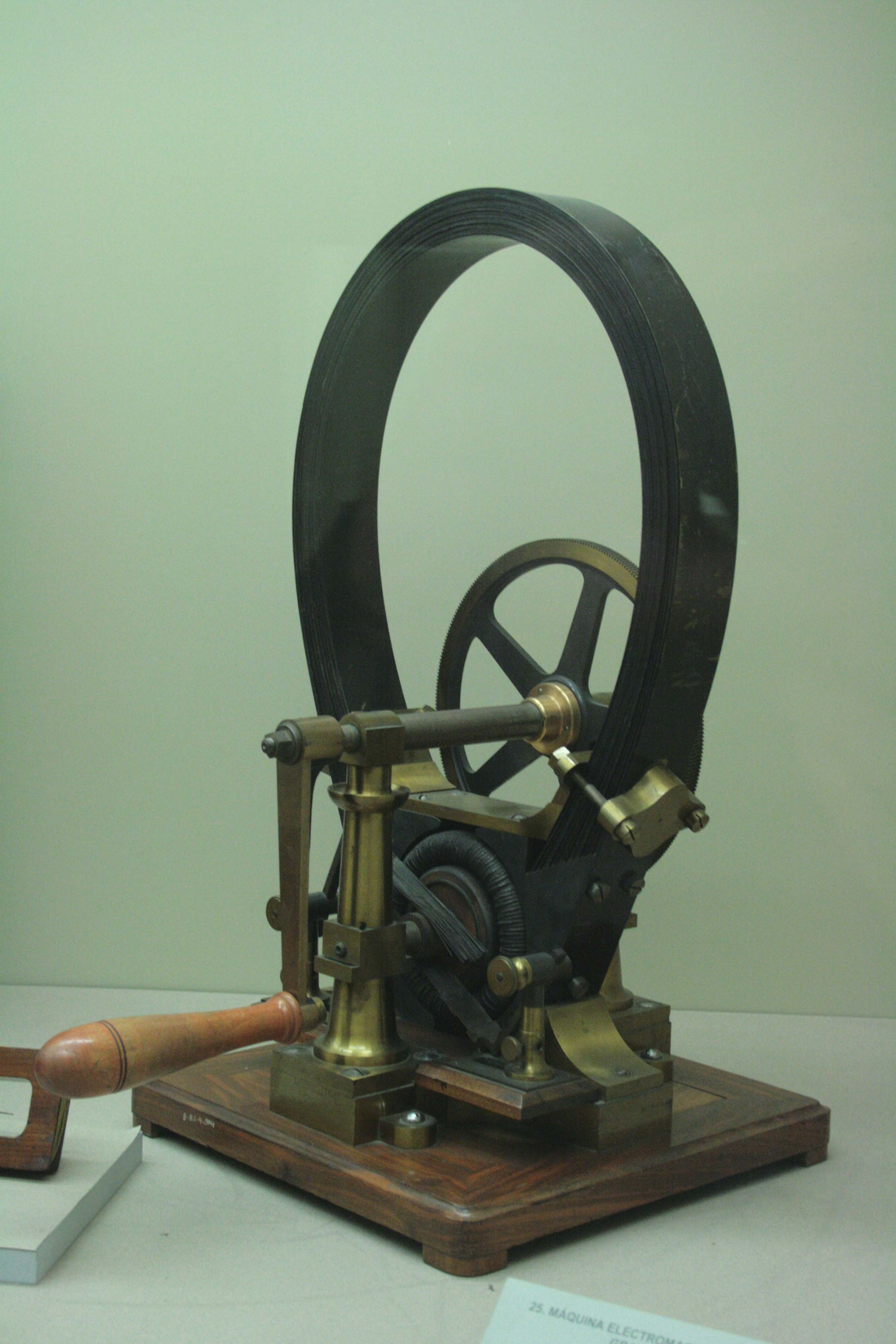
 Gramme Machine
However, to treat the adoption of electric lighting as a purely financial decision, or even a scientific curiosity misrepresents the cultural impact they had on a society that had only ever experienced artificial light that was produced by flame. When outdoor arc lights were turned on in Wabash a witness described the reaction:
No shout or token of joy… disturbed the deep silence that suddenly settled on the vast crowd that had gathered from far and near to witness the consummation of a singular enterprise. The people, almost with bated breath, stood overwhelmed with awe as if they were near a supernatural presence. The strange, weird light, exceeded in power only by the sun, yet mild as moonlight, rendered the courthouse square as light as mid-day (Helm 240).
This scene is frozen in the popular imagination and reiterated in dozens of episodes of The X-Files with the addition of one detail, and the parallel is probably pretty accurate. There is a whiff of ozone in the air. The slack jawed bumpkin stares upward at an eerie, harsh light from on high, speechless and unable to move or react, shortly before he or his cows are abducted and experimented upon. Electric lighting was not just new; it was at the very fringes of science fiction; it was sexy, futuristic, awe-inspiring, and somewhat terrifying.
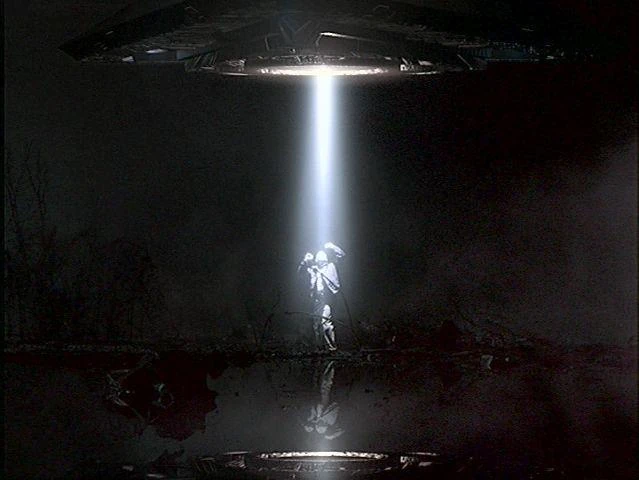
Scene from The X-Files episode "Tempus Fugit"
Soon railway stations, exhibition halls, and other glamorous venues were employing electric lights as much for what they signified as for their illumination ability. And for this reason there are dozens of cases of temporary installations and exhibits that, in conjunction with a multitude of qualifications, mean that there are several electrical ‘firsts’ in many different places. Wabash may have been the first town in the world to be ‘generally lighted’ by electricity, but Wabash was much smaller than Paris or London, which both had outdoor light exhibitions that preceded any in Indiana. Perhaps the reason Wabash can claim this record is that the town was small enough that four arc lights on a flagpole was enough to ‘generally light’ the whole town, or perhaps it is because the town of Wabash paid for the lights rather than a private individual or company, or because they meant to be installed permanently rather than for purposes of trial or exhibition, or all of the above. There are just too many different possible qualifiers to really declare a winner, and too many people arriving at the same inventions independently and nearly concurrently for these records to mean all that much. One thing we know for sure, though, is that by 1891 Telluride had lost the race for the first electric street lights by a mile.
Telluride’s record, the one that we stake out with our own little fingerprint of qualifications, is that Telluride (it was technically Ames) was the site of the first long distance transmission of alternating current for commercial purposes. By 1891 electric lights were already relatively widespread. In fact, Telluride already had a direct current power plant, and by some accounts there was direct current street lighting prior to 1891. Elsewhere, the famous Yablochkov Candle (a type of arc light) used alternating current to make sure that the two carbon contacts were consumed equally. Telluride’s distinction is that alternating current electricity was used as a means to transport kinetic energy that had been generated in one place and needed to be employed somewhere else. A flume was built between Trout Lake and Ames, a drop of a few thousand feet. Water flowed through the flume and powered a turbine called a Pelton wheel at the Ames power plant. The Pelton wheel was connected to an alternator that converted that mechanical energy into alternating current electricity. The electricity traveled through miles of wire that led to the Gold King Mine in Gold King Basin near Ophir. In Gold King Basin, the electricity powered a 100 horsepower alternating current induction motor that spun at nearly the same speed and torque as the alternator in Ames (the small drop in speed and torque was the result of resistance in the power lines). In short, the kinetic energy of the water wheel was turned into electrical energy, which was transmitted just under 3 miles to the Gold King Mine, where it was turned back into kinetic energy that powered a mill.
 The Gold King Mine, the site of the world's first long distance transmission of alternating current for commercial purposes.
In order for this to happen, they needed transformers to ramp up the voltage of the AC power so that it could be efficiently transmitted, and then ramp it back down to a level that the motor on the other end could handle. They also needed an alternating current motor, which had recently been invented by one Nikola Tesla, and finally they needed an ambitious investor looking to prove a point, Mr. George Westinghouse, who was in the midst of a bitter AC vs DC war with Thomas Edison. Westinghouse was convinced to fund the experiment by an audacious Telluride banker named L.L. Nunn, who was losing a fortune buying coal to power his mill, and whose brother just happened to be an electrical engineer. It was a perfect combination to form the experiment that led to the first long distance transmission of alternating current for commercial purposes.
           This was a culmination of a lot of very cutting edge technology, but its real value was as a proof of concept. Perhaps the single most important factor in the AC vs DC debate was that DC power cannot be easily transformed from high to low voltages. Low voltage electricity is great for powering machines, but it is very inefficient to transmit, incurring significant losses over fairly short distances, and requiring much more copper wire. The Ames Power Plant outside of Telluride implemented brand new technology, like the transformer and Nikola Tesla’s alternating current induction motor, to prove that AC power could be transformed to a high voltage, sent through wires, transformed back into low-voltage electricity and used to power an engine, and that this all could be accomplished without incurring prohibitive infrastructure costs.
Prior to the experiment at Ames, hydropower was on the verge of taking over the nation, but the mechanism by which it would operate was a matter of considerable debate. In 1886, there were plans to electrify the city of Buffalo, NY using the thunderous energy of Niagara Falls. The matters of using the water to turn a wheel, converting that rotation into electricity, and using electricity to create light were non-trivial engineering problems that had nevertheless been solved and implemented elsewhere. The real problem was that Niagara Falls, the source of that kinetic energy, was seventeen miles away from Buffalo, NY, the location of the light bulbs, and there was a lot of debate over how to transport that energy. Several proposals were considered, including using compressed air to transport the kinetic energy to a power plant in Buffalo. Ultimately, after years of debate,Westinghouse Electric's resumé at Ames was the proof they needed to win the bid to turn Niagara Falls into an alternating current power plant, transmitting the electricity over high voltage lines to the city of Buffalo.
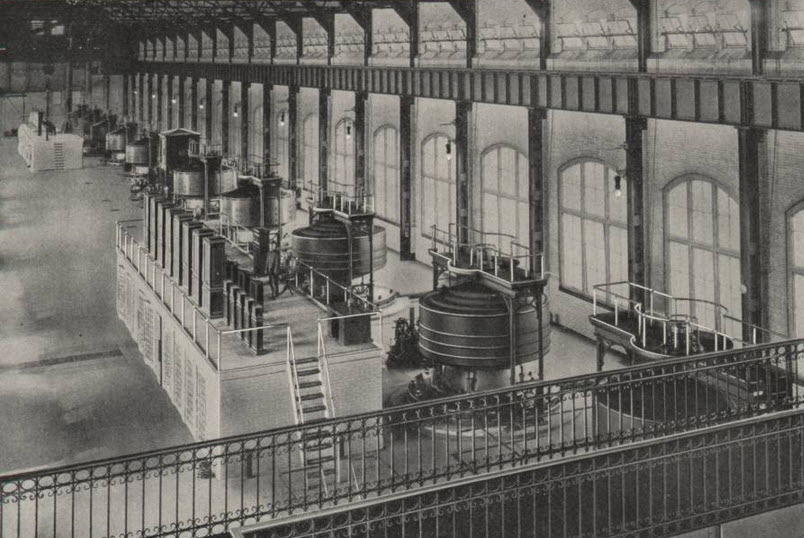

Generators at the Adams Power Plant at Niagara Falls
 
 Massive transformers employed at the Adams Power Plant. Only two years after the Ames Generating Plant provided proof of concept, the difference in scale is staggering.


If pneumatic transmission seems like a comically impractical, steampunk approach compared to electricity, it is only because electric transmission has become ubiquitous; we hardly give a passing thought to the infrastructure that delivers it to our lights and washing machines. Long distance transmission of electric energy and the conversion between mechanical and electrical energy have been optimized and normalized to the point that they have become invisible, but the electrical grid is an enormously complicated machine. Consider that large scale energy storage is impractical and cost-prohibitive. If the power grid needs more power, electrical engineers at a power plant have to spin up a turbine to prevent a shortage, and if there is a lull, they have to scale back power production. Because electricity travels at the speed of light, this all happens in real time, and if electricity generation falls outside the tolerances of the grid, thousands of paying customers will be significantly inconvenienced, not to speak of potential equipment damage. There are entire power plants that sit idle, just waiting for a surge in demand, such as halftime during a soccer game when millions of people turn on electric kettles at the same time. Our power grid is an enormous, byzantine, underappreciated system that did not exist in the 1890s.
The implementation of electricity was one of the most fertile times for inventors in the modern era. The engineering challenge of controlling electricity, not to mention generating, transporting, and transforming it, had been at the bleeding edge of science and engineering for a hundred years, and the experiment at the Ames Power Plant is the culmination of this fecundity, and the proof of concept that launched electrical transmission from a promising curiosity to the prevalence it presently enjoys. In Ames, all of the components of modern commercial electricity were in place. In many ways, the primary difference in commercial electricity between 1891 and today is one of scale. The components were primitive by modern standards, and were quickly improved upon, but they completed all of the necessary functions in much the same way that they do today. Despite the underwhelming heft of the phrase “first long distance transmission of alternating current for commercial purposes,” Telluride’s claim to fame is more noteworthy than the more impressive sounding, but ultimately trivial “first electric street lights.”  

Works Cited
Douglas, J.N.. “The Electric Light applied to Lighthouse Illumination.” The Telegraphic Journal and Electrical Review. Vol. 7 (1879) 135-137. Web. 14 Oct. 2015   

Tocco, Peter. "The Night They Turned the Lights On in Wabash." Indiana Magazine of History [Online], (1999): n. pag. Web. 13 Oct. 2015.

Helm, Thomas B. History of Wabash County Indiana: containing a history of the county; its townships, towns, military records portraits of early settlers and prominent men, personal reminiscences, etc. Chicago: J. Morris, Printer, 1884, 240.
Shoolbred, J.N.. Electric Lighting and Its Practical Application: With Results from Existing Examples. London: Hardwicke & Bogue, 1879. Print.

Slingo, Sir William, Arthur Brooker, and T.F. Wall. Electrical Engineering for Electric Light and Power Artisans and Students: (embracing Those Branches Prescribed in the Syllabus Issued by the City and Guilds Technical Institute). London: Longmans, Green, and Company, 1908. Print.

Wednesday, December 2, 2015

Traditional Holiday Celebrations in Telluride

The sun is spent, and now his flasks
 Send forth light squibs, no constant rays;
 The world's whole sap is sunk;
 
 - John Donne, “A Nocturnal Upon S. Lucy’s Day, Being the Shortest Day”


Italian Catholics and Scandinavian Lutherans alike celebrated Saint Lucy’s Day on December 13th.  It was one of the few Saints celebrated by the Protestants in town. Not unlike Christmas, this holiday has some pagan associations that were incorporated into Christian traditions. St. Lucy’s Day traditionally is held on the shortest day of the year, the Winter Solstice, and Saint Lucy is associated with light. Many of the Christian myths around St. Lucy involve her bringing light to a place of darkness, including one in which she ventures into the catacombs to bring relief to Christian refugees wearing a wreath covered in candles around her head. Additionally the Latin word lucis means ‘light’. In the high latitudes of Northern Europe, the vestiges of pagan traditions and dark winter months made St. Lucy a natural fit. 


These traditions traveled with immigrants from Italy and Scandinavia to Telluride. In Conversations at 9,000 Feet: A Collection of Oral Histories from Telluride, Colorado, Mary Baker recalls: “My mother always celebrated Santa Lucia, Saint Lucy was on the thirteenth of December. We put out cornmeal for her donkey in a little dish. In the morning it would be gone, and there’d be a big orange or apple or something. I believed in that for a long time, even after I knew there wasn’t any Santa Claus” (138). 
Christmas was widely celebrated in Telluride, but the Finnish community celebration stands out for its Old World taditionality. The entire Finnish community celebrated together at Finn Hall, now a private residence at 440 W. Pacific Ave. Parents brought all of their children’s presents and put them under the communal Christmas tree in the Hall, and children performed memorized passages of Finnish. Dinner consisted of lutefisk, (dried whitefish that has been soaked in lye to give it a gelatinous texture) and potatoes followed by coffee and potluck baked goods. In the evening, sleigh bells Santa Claus entered the hall through the door carrying bags of candy and fruit for the children.

 A Gathering at Finn Hall on W. Pacific Ave. on Sept. 4, 1905

For more information, consult Conversations at 9,000 Feet, which is a fantastic resource for Telluride oral history. You can also call the museum at (970) 728-3344 or email lucas@telluridemuseum.org

Monday, August 5, 2013

The Electrifying Truth

Would you know how to create electricity using something like this? Honestly, when I first arrived at the museum, I thought it was a modern art piece. This armature core (about 93" x 48") sits behind the museum as a part of our outdoor mining exhibit, but I have heard countless visitors return inside just to ask how this giant actually works.

The principle for the armature was first developed by English scientist, Michael Faraday, when he made the discovery that if a loop of wire is moved up and down between the two poles of a magnet, a current of electricity moves through the wire. His discovery was improved upon to create something that would produce electric currents. The early AC transformer in the museum's outdoor exhibit works on a modified version of this early discovery. These types of generators produced a large amount of amperage (how quickly the electricity is moving) at a relatively low voltage (how much potential electricity there is).

An armature is made up of a coil of copper wire wound around an iron or steel core. The core is what remains outside the museum. This entire piece is placed in a magnetic field, which is produced by one or more permanent magnets. The armature is then rotated in the field by an outside force, which causes the coil to cut the lines of the magnetic field, just like in Faraday's early experiment. This action creates an alternating current of electricity within the coil.

The next step in this process is finding a way to harness the electricity generated from this process. Wire cannot be directly attached to the coil, because the constant spinning would cause them to wear and break. The solution was the addition of metal brushes, which are placed at the top and bottom of the armature so that the coil spins between them. The diagram below shows how electricity exits through the top brush to light the bulb that is wired to it, and the circuit is completed with the second wire and the bottom brush. Through this brush system, the electricity is harnessed, and ready to use!

Diagram of an AC generator.
Gibson page 195. 

These types of electricity generating devices are most often used in large scale industrial operations, because they are able to produce a large amount of electricity. This type of generator utilizes the armature as a movable core, which maintains an unvarying voltage and prevents electricity from surging and lights from flickering.

Now, when I walk past the core, I not only know that it is not a piece of modern art, but I am more aware of how it works to produce electricity. I hope that this research is useful to our visitors, who want to know a little bit more about this artifact and how it works.


Tierney Dickinson
Summer Intern
Telluride Historical Museum
telluridemuseum.org
_________________________________________________
Charles R. Gibson, The Romance of Modern Electricity: Describing in non-Technical Language What is Known About Electricity and Many of its Interesting Applications, (Philadelphia: J.B. Lippincott Company , 1906 ) http://books.google.com/books?id=p_sHAAAAMAAJ&printsec=frontcover&dq=The Romance of Modern Electricity&hl=en&sa=X&ei=Cvr_UfnFOpKCyAGHo4HIBg&ved=0CDoQ6AEwAA


Monday, March 4, 2013

Dynamic Dyes of Telluride


This cave is near the original cave the Turner's stumbled upon.

It was an average day in 1896 for Mel Turner and his nephew Ed. As they herded stray cattle, meandering through the mesas of Southern Colorado, something on a nearby hill caught their eye. As they grew closer they spied a large cave and the two eagerly scrambled up the hillside to investigate.

Partially buried in the floor of the cave the Turner’s discovered an earthen vessel containing beads, a bone awl, a 16 foot long string of glass beads, and a square textile in nearly perfect condition. Little did Mel and Ed realize that they had stumbled upon what would become one of Colorado’s most prized and priceless artifacts: the Telluride Blanket.

The blanket was woven on a loom with what is called a twill weave. Twill weaves are used today to create denim, and seeing as it is a sophisticated and difficult weave to master, the Anasazi weaver was likely an expert at his craft. The blanket was probably made by a man, as ancient Puebloans traditionally delegated weaving to their men, and it likely served as a “wearing blanket,” or a multi-purpose blanket that provided warmth, helped with heavy loads, cushioned seating, or swaddled infants.

Dated at over 800 years old, the Telluride Blanket has surpassed the typical lifespan of similar textiles by nearly 700 years. According to textile expert Kate Peck Kent, “No other complete specimen exists. There are only two other patterned prehistoric blankets that match this when it comes to its undamaged state.”

Many mysteries still surround the blanket and its history. Where was the blanket made? What was the story of its maker? Where was the cotton harvested for its delicate threads? And what dyes were used to create its vibrant pattern?

The Telluride Historical Museum is excited to host a new program, Cool Colors with Dynamic Dyes on Tuesday, March 5 at 3:30pm. Delve deeper into the history of the blanket, its wild journey to the Museum, and how it has been preserved over time. We will unravel possible sources for the blanket’s rich color and then try our hand at dying our own textile. While all are welcome, this program is best suited for children grades 1-4. Hope to see you there!

Anne Gerhard
Programs and Interpretation Coordinator
Telluride Historical Museum


Tuesday, August 28, 2012

Gentlemanly Pastimes

A gentleman always knows the rules of proper behavior. His appearance is flawless, refined, and never eccentric. His manners exceed expectations, and his moral code is chivalric. He is perfectly bred. From the 1850s on, the etiquette market was inundated with books, pamphlets and manuals defining how to measure up socially as a gentile lady or refined gentleman. After training in manners, morals and decorum, the Victorian gentleman was also encouraged to take up hobby. Not only for entertainment, a gentleman’s pastime developed character, civility, and confidence. 

The Rules of Etiquette and Home Culture 1886 read"It is the duty of a gentleman to know how to ride, to shoot, to fence, to box, to swim, to row and to dance."
With the population of Telluride near 5,000 at the height of the gold rush in the 1890s, the men of Telluride undoubtedly had a vast choice of character building hobbies. Seemingly, the most popular was a civil game of poker at one of the many saloons or parlor houses, but the Victorian era was also when baseball first saw developments towards the All American game we know today.
  
Catcher's Mitt, THM Collection
The first set of rules were laid down in 1845 by Alexander Cartwright, founder of New York City’s Knickerbockers club - one of the first organized baseball teams to play under a set of rules. Marked by the spirit of gentlemanly sportsmanship, baseball soon became known as the "gentleman's game." The strategy of the era was base hits, stolen bases, and hit and run plays. The home run? That was considered so boring it was worthy of rotten tomatoes being pitched at the hitter. It wasn’t until Babe Ruth made the home run a famous achievement of strength in baseball that a "hit out of the park" was celebrated.
 
Telluride Team, Western Slope Champions 1913

Telluride has a long standing tradition of baseball. In 1913, the Telluride Baseball Team became the Western Slope Champions and in 1964 the team won state. During baseball season town park fills with teams cheering, yelling, heckling, winning and losing. Baseball camaraderie gives a sense of community and sportsmanship. The gentleman's game has now also become a ladies game, and the sidelined fans patiently await the home runs.


~ Cameo
Exhibits Curator
Telluride Historical Museum


Sunday, June 24, 2012

Fair Audrie of Telluride


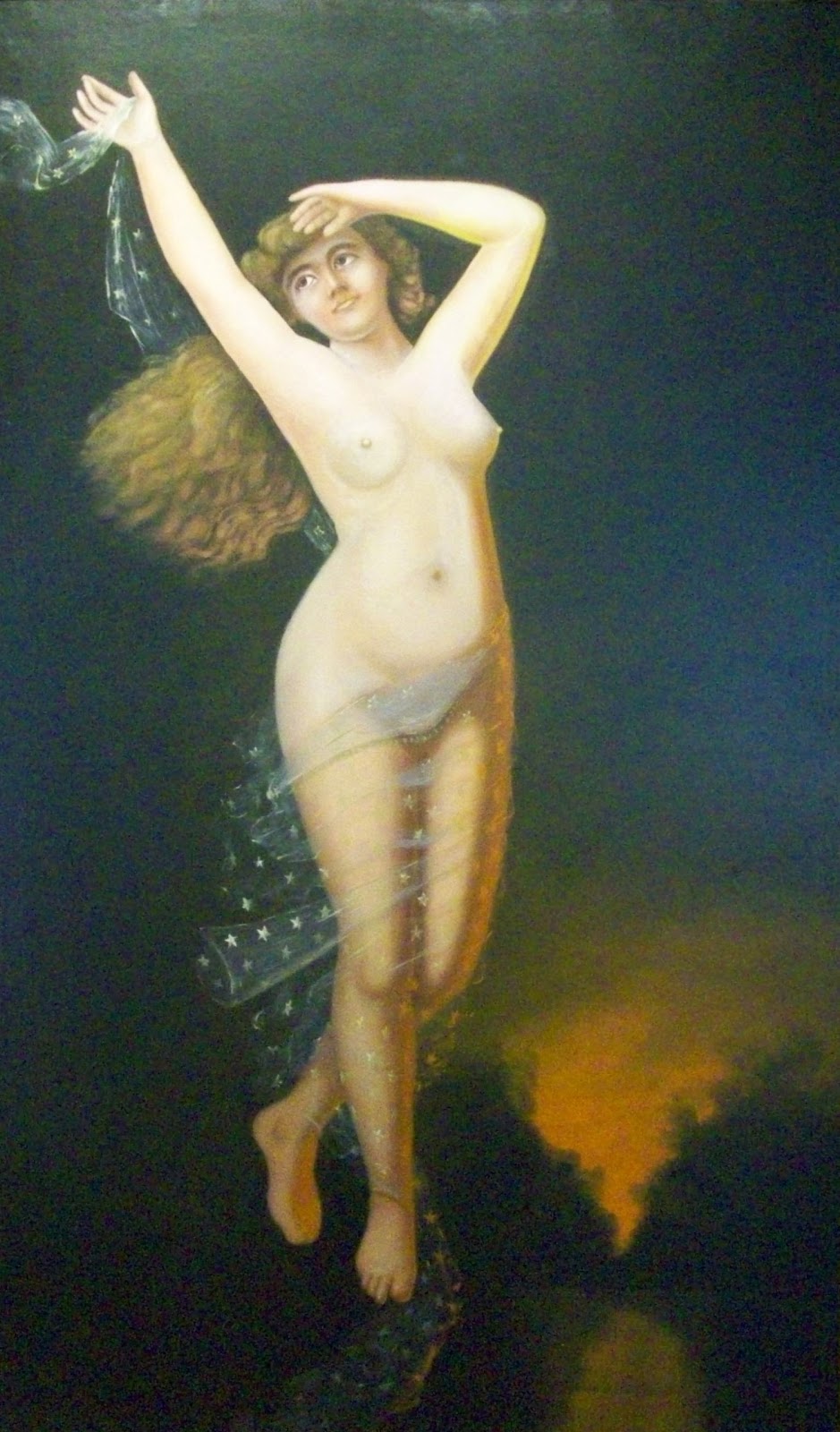
"Audrie" by Jim Shane
On loan from Kim Sheek

The story of this iconic portrait begins with a wayward drifter, James Shane. Struck by gold fever, he stumbled into Telluride in the 1890s looking to secure a ‘grubstake’ (prospecting supplies or a money advance in return for a promised share of profits). Not a soul would lend to him though, for they had already judged his character by his well-groomed hands. Jim turned to the piano instead, playing in the red light district at parlor houses and saloons for small wages and a warm bed.

Audrie Shane c. 1900
Courtesy of Robert Wilson
Jim sometimes spent weeks at a house. The ladies cared for him, fed him, and were entertained by his music. After a fortnight of entertaining at the Pacific Avenue house in Popcorn Alley, word spread that he was also an artist. One lady of the night in particular, Audrie Fort, took special interest in his artistic ability and proposed an attractive business deal: if Mr. Shane would paint a portrait of her, he could sell it to a local establishment, giving him enough money for prospecting. In return, the portrait would serve as advertisement for Audrie hanging in a proper establishment about town.

During the course of completing the painting, Audrie Fort and Jim Shane fell in love. He sold the painting, went prospecting, struck gold, and married Audrie. With a successful business of buying and selling profitable claims, they built a respectable life together in Telluride until 1936. It was a true love story.


Jim, Audrie and daughter Nina, at their Telluride home, 1896
Photo courtesy of Robert Wilson
The painting was displayed in about every saloon in Telluride including the Diamond, the Roma, the Beer Garden and eventually in a private gambling room above Frank Wilson's drugstore, the Busy Corner Pharmacy. Audrie had been around town, but when the Colorado attorney general cracked down on private gambling, the club closed and she was left abandoned. 

Over the next 20 years, Audrie endured the filth and grime of time. She was headed for the dumpster when Robert Wilson saved her. He cleaned her up and hung her downstairs in the Busy Corner Pharmacy. There Audrie hung until the business closed in 1968. The portrait was then loaned to the Sheridan where, after some unfortunate damage, she required professional conservation. Robert had gifted the portrait to his daughter, Kim Sheek, who gave the portrait new life at the Rocky Mountain Conservation Center in Denver.

We continue to learn more about the story behind this iconic portrait. Audrie's name, for example, was long known in Telluride to be spelled "Audrey Ford." After meeting with two of Audrie's grandchildren, Robert Wilson learned the correct spelling was in fact "Audrie Fort."

Audrie can be seen up close and personal at the Telluride Historical Museum in all her colorful, lady of the night glory.

Shine on Audrie! Shine on...

~ Cameo Hoyle
Exhibits Manager
Telluride Historical Museum
telluridemuseum.org

Monday, April 16, 2012

The Game of Faro


Faro Card Table c. 1910 - THM Collection
Favored because the odds of winning were greater than any other gambling game, Faro was played in almost every gambling hall in the Old West. Its easy to learn rules, fast action play and gainful odds against the house gave it popularity among the gambling masses. In 1882, a New York Police Gazette study estimated more money was wagered on Faro in the U.S. each year than on all other forms of gambling combined.

Surviving its forbidden play in France during the reign of Louis the XIV, the late 17th century French gambling card game came to the U.S. in the 19th century. It infiltrated the Old West saloons with vigor and this game of chance soon became a dangerous scam.

The game was played with one deck of 52 cards and as many players, "punters", that could fit around the Faro table. Unlike most games in the gambling hall, faro was not owned by the saloon proprietor but instead by the faro dealer. He owned the table, cards, all the faro equipment, and put his own investment down to cover the bets of the game. One of the most famous faro dealers to set up in the west was Wyatt Earp who dealt faro in Tombstone when he first arrived.


To play the game, gamblers placed bets on the thirteen card Faro table layout. Flat bets, split bets, copper bets, high card bets -- all betting on the winning card or the loser. The dealer then draws two cards from the "Faro Box." The first card drawn, the bankers card, was the loser and the second was declared the winning card. So, if you had placed your chip on the Ace, and the Ace was the winning card you received a matching payout.

Faro Case Keep c.1910
THM collection
The Faro Box and Case Keep were employed to ensure gamblers fair play. However, since the equipment was owned by an entrepreneur, it soon became a false sense of  security. The gaffing of a Faro Box was so prevalent that rigged boxes were openly sold by catalog companies.
The final bet, when there are only three cards left in the deck, is known as a “Calling Turn.” It was the most popular and exciting point in the game. Players bet on what card would be dealt as the loosing card, the winning card, and the “Hock,” the last card which is not used. If you hit this bet, it paid four to one.


If you want to take your chance and belly up to the Faro table, follow this link for an online version:

http://www.gleeson.us/faro/game


~ Cameo Hoyle
Telluride Historical Museum
Exhibits Manager
http://www.telluridemuseum.org/

Thursday, February 23, 2012

Quilting Decoded

Last week we celebrated the opening of our newest temporary exhibit, Harvest of Heritage. The touring exhibit created by the Museum of Western Colorado, funded by the National Endowment for the Arts American Masterpieces Program and presented by Colorado Creative Industries, displays artists works linked to Colorado’s rich agricultural heritage. Artists chosen for inclusion in this exhibit have met the highest standards of the Colorado Creative Industries’ Cultural Heritage Program. Many have been awarded state grants and fellowships to help them preserve, present, pass on and celebrate their traditional art form. Two have received the National Endowment for the Arts’ highest honor for our nation’s tradition bearers. Many have served as master artists who have passed on skills and knowledge to a next generation of apprentices. Their stories bring our state’s history and geography to life.

The museum has contributed a few of its own artifacts to the exhibit while it is being housed there for six weeks. The artifacts celebrate Telluride's heritage through traditional art form, and just like the others displayed; they too have a story to tell.

The cotton gold and cream double hourglass patterned traditional quilt had been authenticated by the Colorado Quilting Council in 2005 as a historic quilt. The general knowledge of its construction and fabric content were noted. Beyond that however, the museum currently has no information on its origination. Admittedly I was interested in it mainly because it matched the yellow color theme of the exhibit, but also its intricate hand stitching and simple design has impact. It seemed special, magical. In honor of the Harvest of Heritage exhibit and having heard that every quilt pieces together a story, I felt compelled to research the story of our quilt's pattern.

Most quilting bees were social gatherings of women helping a friend or neighbor finish a quilt, and more often helping a bride-to-be finish her quilts before she married. Women could share family news, exchange recipes, and give child-rearing tips. Quilting was a social asset, and next to church, going to quilting bees was the primary contact for women.

It is speculated the hourglass quilt pattern was originally developed as “quilt code” by the Sealcott Indians to help fugitive slaves escape north to freedom. These coded quilts would have hung outside windows or on fences advising escaped slaves when and where it was safe to travel. The color of the hourglass indicated what time of day help would come: red for morning, yellow or green for afternoon and blue or black for evening.[1]

"Quilt code" is a highly debated subject, with many theories on the code's existence, or non existence. Myth or fact, the idea of quilt code empowers and adds mystery to the unknown story of our own traditional gold and cream double hourglass patterned quilt.
~
Cameo Hoyle
Exhbits Manager
Telluride Historical Museum
http://www.telluridemuseum.org/


Referenced:
[1]  http://ugrrquilt.hartcottagequilts.com//

Wednesday, December 21, 2011

Smile for the Camera

The snapping of the camera shutter is all too familiar during the holiday season as families in their Sunday best cheerfully pose for portraits and children “cheeeeeezzz” for Grandma unwillingly.

Historically, portraiture was reserved for aristocracy, painted on canvas, and documented the sitter’s nobility. Ordinary middle class peoples looked upon portraiture as an extravagant expression of superiority. As democracy rose and middle class demanded bourgeois luxuries, artists responded with miniature portraits and silhouettes. However, those archetypal substitutions could not survive the invention of the Daguerreotype in the mid 19th century. The Daguerreotype (the first successful commercial photographic process) made portraiture affordable, although at first only afforded by the well-to-do.

Today, photographs capture sentimental moments like fleeting memories, but photography wasn’t always so candid.  Before the camera became a commodity and Uncle Joe could snap the family portrait in half a second, having your photograph made was luxury and privilege. The photographer’s studio was a fixed business establishment and a scheduled appointment was a must. However, the realization of cameras with built in processing freed the photographer from his studio by mid 19th century.

Portraits then came in all sizes, from small pocket sized to lockets and mantle wedding portraits. Street photographers solicited on boardwalks by the beach, cameras were toted to picnics, and even the Civil War. Portrait enthusiasm also developed into sentimental jewelry with the invention of the photo button camera in 1910.

A curious type of photo found in our collections is not a wearable button, but instead a six inch button plaque stamped Chicago Portrait Company on the back. Founded in Chicago about 1893, this innovative portrait company took full advantage of street photography. They sent out photographers (really salesmen then called “drummers”) to travel the country and take portrait photos. The film was then mailed to headquarters, printed, mounted and mailed back to the customer.

The button plaque was a popular alternative to the traditional framed portrait. Not only was it small and portable (important for a booming mining town where space was a disappearing commodity), but it was also affordable because of its tintype photo process, the faster cheaper way to produce a print.

We haven’t identified the woman in the portrait, but can trace the artifact to the McPhee estate in Telluride. Their lineage is a mystery other than John McPhee who published a local newspaper covering Norwood, Nuclea, and Telluride news.


~ Cameo Hoyle
Exhibits Manager
Telluride Historical Museum
www.telluridemuseum.org

Wednesday, September 14, 2011

Velocipede for Two

In 1894, while working at a small bike shop in New Castle, Indiana, Charles Teetor built a fine bike for his wife. Soon after, the Division Superintendent of the Chicago and NW Railroad, Charles Hartley (also cousin of Mrs. Teetor), saw the bike. "Build me a bike that will ride the rails!" Hartley requested.

You see, the only way Mr. Hartley's inspectors could perform their rail inspecting jobs was by walking the tracks or firing up a locomotive, neither very efficient. At the height of the industrial revolution however, efficiency could not be thrown under the train. A year later the Railway Cycle Manufacturing Company was founded in Hagerstown, Indiana by the Teetor brothers.

The cycle debuted with much debate. Inspectors were sure biking the railroad would be a hassle. It would be too much work to pedal the bike and just plain inconvenient. However, almost immediately after its debut, the lightweight quad cycle was adopted by railways across the nation and also the mines.

With underground tunnels spanning miles, mine staff covered large distances on foot (or perhaps if lucky, catch a passing ore train) to reach different designated working areas within the tunnels. In Telluride, these distances could sometimes be more than five miles and increase in elevation by 1600 feet. That's a lot of beat for a shift boss.

The rail mounted cycle began use in the Telluride region around the early 1900's, but was abandoned in the 1930's. Some thirty years later, the Idarado Mine Superintendent, Dick Swerdfeger, revived the use of a mine bike after walking a visiting geologist through miles of the Idarado Mine. He knew of the quadcycle from early mine drawings, but hadn't known he could order the fantastic invention until the visiting geologist made the connection for him. He put Dick Swerdfeger in touch with the V-Plex Clutch Corporation, the successor to the Railway Cycle Manufacturing Company and makers of the Teetor Light Inspection Car. Mr Swerdfeger ordered one.


1919 Teetor Light Inspection Car

A mine bike hadn't been used in the local mines since the depression era, and with industrial improvements on diesel powered mining locomotives, the mining crew was greatly amused by the prospects of running over the Superintendent on his "quadcycle." Determined to prove the crew wrong, Swerdfeger took off on a mine bike pilot test a few minutes ahead of the first morning crew train. Two miles later he arrived at his first stop, the main service raise location. The train arrived ten minutes later with a surprised, and maybe somewhat disappointed crew, saddened because they didn't have the opportunity to give the Superintendent a good bump on the bike tail.

Our 1919 Teetor Light Inspection Car now exhibited in the museum was rescued from the Atlas Mine dump above the Ajax mine and donated to us in 1970. Ten thousand rail bikes were still in service in 1971. They often transported more than one mine employee by piling as many as the peddler could withstand on the back platform.

FUN FACT: Despite an accident that left him blind at the age of five, Charles Teetor's nephew, Ralph Teetor, became a brilliant automobile engineer and invented the speedostat (more commonly known as cruise control). What year did cruise control debut? 1958 on the Chrysler Imperial.

~ Cameo
Exhibit Manager
Telluride Historical Museum

Tuesday, August 9, 2011

What the heck is it?!

It's a bird! It's a plane! It's a Crosley Dynacone! And in 1929, you could have one for $25.00. It was the choice for radio lovers in every modern American household of the period. One could say it was a must have radio accessory, known for its sound reproduction and affordability.

On August 31, 1920, the first known news radio program was broadcast in Detroit, Michigan. At the same time, Powel Crosley founded the company that pioneered radio broadcasting. The story goes, Mr. Crosley wanted to buy his son a radio for his birthday but the steep price of $130 dollars was unacceptable. Crosley decided to build his own radio for cheaper and when his finished radio only cost him $35 to build, he was inspired to build for the masses. The first mass manufactured radio, the Harko, sold for $9 and became so wildly popular that Powel Crosley became known as the "Henry Ford of Radio." In 1927 Crosley Radio was the number one radio manufacturer in the world.

 During the mid 1920s the Crosley Dynacone amplifying speaker revolutionized the way was radio heard. Radio static was a listener nightmare before the introduction of FM radio in 1933 and manufacturers were constantly challenged to provide clean, clear sound.  Crosley once again rose to the challenge and produced an affordable, all American product for every household. Connected to a Crosley Showbox radio receiver, the Dynacone's field magnet technology reduced the static sound of AM radio producing dynamic tone and volume.  It not only had enough sound to fill a dance hall but also captivated radio hour listeners. It's not hard to imagine our Crosley enthralling an audience at the Busy Corner Drug Store or even whispering a tune at the Pekkarine Mercantile.

Like HDTV and plasma picture to today's television viewer, the Crosely Dynacone was an innovation that gave your everyday Joe unsurpassed listening pleasure.

Tuesday, June 14, 2011

LAYIN' DOWN THE LAW
TELLURIDE LAWMEN, OUTLAWS, and CRIMES

On June 2nd, the Telluride Historical Museum greeted the summer with our new exhibit "Layin' Down the Law: Telluride Lawmen, Outlaws, and Crimes." With three years in the making, there was much to celebrate. Artist Rick Unger and musical performer Fred Hargrove worked in collaboration to honor an admired and well remembered sheriff from Telluride's history, San Miguel County Sheriff Guy Warrick. Mr. Unger unveiled his colorful portrait of "Sheriff Guy Warrick, Somewhere in Telluride Time, " for the first time to a host of guests and museum staff. Fred Hargrove wrote "The Ballad of Guy Warrick," which also made it's debut at the exhibit opening. The event packed evening continued on with a Squidshow Theater giving it's captivated audience a show stopping performance of “Cops, Crimes, and Criminals.” Everyone is still talking about it.


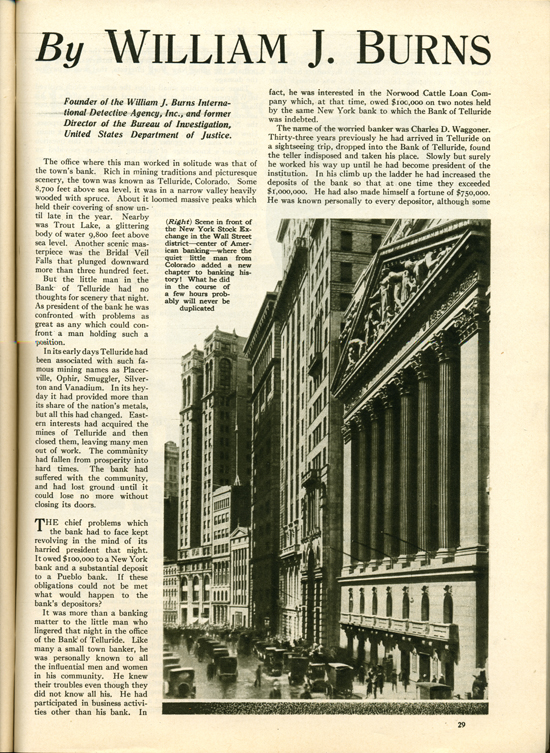
The exhibit not only focused on Telluride lawmen and notorious outlaws, but also their outrageous crimes that often gained national attention. The infamous Butch Cassidy pulled his first bank robbery in Telluride, but he wasn’t the only one who looted the banks. Charles D. Waggoner, Bank of Telluride President in 1929, swindled $500,000.00 from the big New York banks to pay off BOT debts in a time of economic downturn. Accounts of his “Robin Hood” crime could be found on front page newspapers throughout the nation.

However, the newspapers withheld all the juicy details that citizens of the time were craving. Debuting on the newsstands in 1924, non-fiction true crime magazines became a popular alternative to newspapers. These magazines gave detailed retellings of murders, swindles and mysterious cases that the papers would not reveal. 

Many early issues of crime magazines are now rare and difficult to find. However, with diligent research we were able to locate and bring into our collection four true crime magazines, all of which highlight some of Telluride’s most notable crimes. Seeing all the museum supporters greatly enjoy the entertainment and new exhibit is delightful, but the excitement of acquiring new artifacts to our collections is, well… exciting! They were a rare find indeed! 

The April 1931 issue of True Detective Magazine features the gripping story of how C.D. Waggoner deceived Wall Street. It is now on display in the "Layin' Down the Law" exhibit with the three additional true crime magazines we recently acquired.


Until next time, blaze a trail... just don't shoot anybody.


Cameo
Telluride Historical Museum
Exhibits Manager
http://www.telluridemuseum.org/


Listen to the Ballad of Guy Warrick
Written and performed by Fred Hargrove

Get this widget |Track details |eSnips Social DNA


EXTRA! EXTRA! READ ALL ABOUT IT!
Can't get enough? The Telluride Historical Museum blog can now be read on your smart phone! Scan the QR below to follow our blog no matter where you are!
QR code of mobile preview of your blog