Tuesday, June 14, 2011

LAYIN' DOWN THE LAW
TELLURIDE LAWMEN, OUTLAWS, and CRIMES

On June 2nd, the Telluride Historical Museum greeted the summer with our new exhibit "Layin' Down the Law: Telluride Lawmen, Outlaws, and Crimes." With three years in the making, there was much to celebrate. Artist Rick Unger and musical performer Fred Hargrove worked in collaboration to honor an admired and well remembered sheriff from Telluride's history, San Miguel County Sheriff Guy Warrick. Mr. Unger unveiled his colorful portrait of "Sheriff Guy Warrick, Somewhere in Telluride Time, " for the first time to a host of guests and museum staff. Fred Hargrove wrote "The Ballad of Guy Warrick," which also made it's debut at the exhibit opening. The event packed evening continued on with a Squidshow Theater giving it's captivated audience a show stopping performance of “Cops, Crimes, and Criminals.” Everyone is still talking about it.


The exhibit not only focused on Telluride lawmen and notorious outlaws, but also their outrageous crimes that often gained national attention. The infamous Butch Cassidy pulled his first bank robbery in Telluride, but he wasn’t the only one who looted the banks. Charles D. Waggoner, Bank of Telluride President in 1929, swindled $500,000.00 from the big New York banks to pay off BOT debts in a time of economic downturn. Accounts of his “Robin Hood” crime could be found on front page newspapers throughout the nation.

However, the newspapers withheld all the juicy details that citizens of the time were craving. Debuting on the newsstands in 1924, non-fiction true crime magazines became a popular alternative to newspapers. These magazines gave detailed retellings of murders, swindles and mysterious cases that the papers would not reveal. 

Many early issues of crime magazines are now rare and difficult to find. However, with diligent research we were able to locate and bring into our collection four true crime magazines, all of which highlight some of Telluride’s most notable crimes. Seeing all the museum supporters greatly enjoy the entertainment and new exhibit is delightful, but the excitement of acquiring new artifacts to our collections is, well… exciting! They were a rare find indeed! 
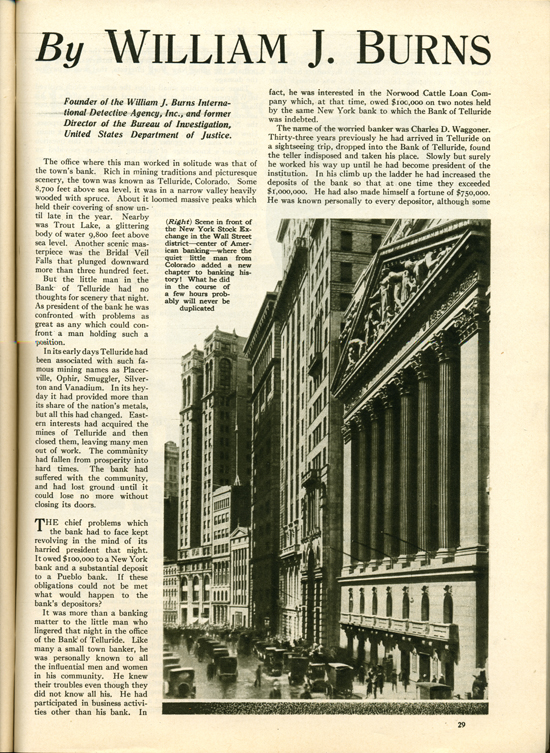
The April 1931 issue of True Detective Magazine features the gripping story of how C.D. Waggoner deceived Wall Street. It is now on display in the "Layin' Down the Law" exhibit with the three additional true crime magazines we recently acquired.


Until next time, blaze a trail... just don't shoot anybody.


Cameo
Telluride Historical Museum
Exhibits Manager
http://www.telluridemuseum.org/


Listen to the Ballad of Guy Warrick
Written and performed by Fred Hargrove

Get this widget |Track details |eSnips Social DNA


EXTRA! EXTRA! READ ALL ABOUT IT!
Can't get enough? The Telluride Historical Museum blog can now be read on your smart phone! Scan the QR below to follow our blog no matter where you are!
QR code of mobile preview of your blog

Friday, April 8, 2011

Saddle Up!

First invented in the 1380's as a means to protect the virginity of aristocratic girls while riding, the primitive sidesaddle was chair like with a padded seat and a crude plank stirrup large enough for two feet. By the turn of the century, riding sidesaddle became a social expectation, an expression of women's modesty. However, the streets were not crowded with side saddling women, as most women couldn't afford a horse of their own. Besides, what woman would want to soil their dress or evening gown riding open when one could sit comfortably in a carriage? None the less, women who did ride often had special clothing for the occasion.

How does a woman sit on sidesaddle, anyway?
After being hoisted on the saddle by two men, the rider's right leg hugs the top (fixed) pommel, which supports her thigh and the leg then rests along the shoulder of the horse. The lower pommel, or the leaping horn, curves over the top of the rider's left thigh. The leaping horn pivots slightly to adjust to the rider. There is a single stirrup for the left foot. The lower pommel, which gives women more security and movement, was a revolution to the sidesaddle added in the 1830's. This simple addition allowed women to stay on when the horse was in gallop, or jumping. Women then began to take up sporting such as fox hunting and competition.

Our side saddle dates to 1880's and was originally used by Margaret McKenna at the McKenna Ranch in Cedar, Colorado near Disappointment Valley. While Mrs. Eva Daniels, a school teacher, lodged at the McKenna Ranch, she rode the side saddle to the San Miguel Schoolhouse approximately thirty miles to teach.
It is a western style sidesaddle determined by it's square double skirting and fleece lined underside. The flat seat also gives away it's western origin, and allows for the rider to have more freedom of movement. Something a woman needs on a working ranch, or long rides.

When did the sidesaddle go out of style?
The single biggest movement that extinguished sidesaddle usage was Women's Suffrage. Mobility was synonymous with escaping a male dominated society. Women desired to escape the social institution that classified women as a lesser gender. Suffragettes rode into the voting booths on sidesaddle then rode out astride to attest their independance. So saddle up, ladies! Declare your independance and ride both sides of life, or celebrate your unique elegance and sidesaddle it with style!

Famous Women who rode sidesaddle:
Catherine de Medici
Marie Antoinette
Queen Elizabeth II
Catherine the Great (until she had a portrait painted of her riding aside wearing a male officers uniform!)

This photo came to me from the Wilson family. That's Goldie sporting the side saddle and her owner Gladys Wilson enjoying a sunny Telluride afternoon.


~ Cameo
Exhibit Manager
Telluride Historical Museum
http://www.telluridemuseum.org/

Wednesday, February 23, 2011

What's the special?

  
Busy Corner Pharmacy c. 1940. Photo courtesy Robert Wilson.
 In 1921, Frank B. Wilson and business partner, R.W. McAnally, purchased the Baisch Drug Store on the corner of Fir Street and Colorado Ave. They renamed it the Busy Corner Pharmacy and Frank Wilson remained the big cheese at the store until 1965.

The pharmacy was a keystone in Telluride history for more than fifty years and was much more than just some swell place to get your antidotes. Inside the store you could also find cosmetics like liquid pantyhose, buy some “cheaters” (otherwise known as spectacles) grab a snack, get your licorice fix, and have a malted milk shake with your besties. 


In the early 1900s a malt shop was primarily offered out of a drugstore. The term malt itself comes from “malted milk.” Invented in the 1880’s, it’s a mixture of malted barley, wheat flour, and whole milk dried to a powder form. Many fountain drinks and malts before 1914 were extracts of various drugs, cocaine and caffeine being the most known, but also various plant extracts. They were dispensed as a flavored effervescent remedy for your ailments, explaining why the soda fountain was introduced in the drug store. However, “giggle water” sales changed when the “Harrison Act” became a law in 1914 banning the use of cocaine and opiates in over-the-counter products. Shortly after, soda was thought to be “habit forming” and the soda fountain lost its popularity, but only for a short while. Advertisers soon coined the term “soft drink,” advertising the new fountain beverages as “not intoxicating.”

By the early 1920’s just about every drug store had a malt shop or soda fountain. They exploded in popularity during this era most likely due to 1919 prohibition. Closed saloons left a social void that the soda fountain hang outs could now fill. They soon added fare like sandwiches and burgers making the corner drug store the new cat’s meow.

This Busy Corner Pharmacy Menu, circa 1924, popped up in our collections as I was scavenging for a small off site exhibit housed in the now empty pharmacy building. It immediately interested me as a token of  a youthful past that must have been a real applesauce of a time!

Busy Corner menu fare in the 20's:
Sandwich ........... 25 cents
   sandwich spread, peter pan, cheese, hormel ham, or minced ham
   Milk or coffee with order and tomato juice

Soda ..................5 cents
  Orange-Julep, Root Beer, Coca-Cola, Cherry-Julep, Grape-Julep, Plain

Ice Cream Soda ....15 cents
  Chocolate, Orange-Julep, Strawberry-Julep, other flavors

Sundaes .............. 20 cents
   Chocolate Nut, Orange-Julep, Strawberry, Cherry-Julep, Marshmallow

Malted Milks ........20 cents
   Plain, Orange Julep, Chocolate

Fancy Mixed Drinks ..... 15 cents
   Milk Chocolate, Orange or Cherry Julep, Eskimo Freeze, Milk Shake, Frappe, Parfait
 
I wouldn't know what to spend my rubes on first!
     ~ Cameo 
      Exhibits Manager  
      Telluride Historical Museum

Sunday, January 16, 2011

The Mysteries of a Woman

Our Museum is packed with mysterious jewels of history. Mostly, these precious gems were donated from families who have lived in Telluride for generations. Although the family might not know the true origin of an artifact, we can usually trace back at least a hundred years of its history. However, there are instances when an artifact found in collections has no known history or reference of to how it came to Telluride.

During storage organization, I found this beautiful little treasure in a box full of miscellaneous frames. She captivated me, even in the dark corner of the Museum attic. I rushed her out to the light and examined her under spyglass searching for a signature, date, or some indication of who she was. I so desired to throw organizing duties into the wind and bury myself in piles of research. Who was she, who was the artist, was there a Titanic story line hiding beneath the layers of paint? I set her aside on my desk for days until I could steal any spare moment to uncover her mystery.

She greeted me daily for weeks. I sent inquiring details to art history scholars, Rennaissance Art experts and to Denver Art Museum curators. The only telling qualities I could decipher were the shoes at her feet, most likely Dutch, and her full round figure reminiscent of 17th century Baroque styles.[1] While these two styles were noticeable to researching scholars, we all questioned the color palette and the bonnet which seems strangely out of context. Among the responses, the most agreeable is that she is not a true 17th century century Baroque work of art, but most likely a late 18th or early 19th century American artist's study. Most American Colonial artists, having limited access to European art, often used black and white engraved reproductions to study from.[2]

Even though Dutch influence is apparent, the painting's current residence, history of our mining town, and her explicit nature led curators at the Denver Art Museum to speculate her be an example of early 19th century American Erotica. Considering a large amount of  early Telluride's population was male, I like to think it's possible we had a talented practicing artist who made a living by selling color interpretations of Dutch women on display. But most likely, that's my own romantic novel in the making starring an artist who is madly in love with the model.

If the painting were to ever undergo restoration we might be able to uncover her true identity by revealing the original color palette and painting technique. Until then, she remains an admired mystery.

~ Cameo
Collections Assistant
Telluride Historical Museum

**Note to readers: Watch for our upcoming "Adopt an Artifact" program and send our Woman of Mystery to restoration!


[1] Referenced: Campbell, Andrea <acampbell@randolphcollege.edu>. "Mysterious nude" private email to <cameo@telluridemuseum.org>, 27 Sept. 2010.
[2] Placidi, Kathleen <kplacidi@sbc.edu>. "Mysterious painting" private email to <cameo@telluridemuseum.org>, 27 Sept. 2010.


Saturday, December 11, 2010

70's Telluride Holiday Cheer

The holidays are upon us, and it seems the already bright Telluridian smiles only get wider and brighter this time of year. I saw several big bright smiles during our 70's exhibit opening, as locals who have celebrated 30 plus Telluride Christmases strolled down memory lane. There was a lot of "mountain freedom" story sharing followed by rolls of laughter, and "yeah, we did that!" They bonded over remembering the Roma, Silver Jack, and first ski runs on the new slopes.

In light of celebrating the 70's, I pulled a December, 1971 Telluride Times from our archives with a striking picture of Linda Schoder's fourth grade class in front of the Busy Corner Pharmacy. They won first prize in a tree decorating contest, and got a snowcat ride to the top of the mountain to see the beginnings of the "Big T" ski area!


The photo reminded me of the camaraderie our long time locals shared while celebrating 70's Telluride, and I thought I'd highlight some of the Christmas events that took place December, 1971:

Telluride School children were let out of class in the 70's to decorate the main street trees for Christmas.

The highlight of the Christmas social gatherings was the Commonwealth Club party at the home of Alta Cassietto.

On Christmas Day, Telluride Firemen distributed candy to children promptly at noon in front of the courthouse where Santa Claus also promised to appear.

Eddie Baer graced the piano at the Sheridan for the holidays.

And, one of my holiday favorites... if you wanted to catch a movie, the Nugget had When Dinosaurs Ruled the Earth, "Big Jake" and Pinocchio on the big screen.

Happy Holiday's Telluride! Make it memorable!
~ Cameo

Friday, November 12, 2010

Keeping Time

This circa 1880 Regulator clock hung in Harry Miller’s Barber Shop in 1904 on Colorado Avenue until it was gifted to Dr. Parker at the Telluride Community Hospital. Later, when the hospital became the Telluride Historical Museum, Dr. Parker donated the clock so it could remain in the building. Today the clock is on display, albeit without tick or tock, in our gift shop.

For many years the pendulum sat detached inside the case. Recently, we had it re-hung and the clock appraised for conservation. We discovered it is a Model Regulator clock made by the New Haven Clock Company in New Haven, Conn. The clock originally had a pediment on the top and depending on the case design it could have been a buck head or a ladies bust, both popular subjects in 1880’s Telluride.

Our Regulator is probably one in a hundred made from the New Haven Clock Company, who was producing over 170,000 clocks a year by 1860! Most likely ours was made in the late 1880’s when Standard Time was introduced.

Regulator clocks were the standard for Railway Stations, Banks, and anywhere time was paramount. The Telluride Historical Museum would like to have the clock cleaned so the pendulum will swing and turn the hands of time forward, once again, making history.

~ Cameo
Telluride Historical Museum
Collections Assistant

Friday, October 8, 2010

The Relief Train

 For some, inventory can be daunting. For myself, Collections Assistant at the Telluride Historical Museum, it is fascinating. Each museum’s collection has its own story, its own local history. Sometimes, even in this small town museum, our own quirky history surprises us with a story and influences others beyond local lore to call upon our stories for a smile.

During my inventory adventure, I have delighted in many objects from turn of the century. Anything from celluloid vanity sets to dog collars, grand wide brim hats we only see in historical movies, and even late 19th century roller skates. But what has caught my interest of late is the story of a flood, a mountain town that was subject to starvation, and a man who thought salvation was beer. Yes beer.

Telluride’s most notable historian of the era, Harriet Fish Backus, recalls in her book Tomboy Bride the 1909 Trout Lake Flood that washed out 30 miles of train tracks to Ridgway, the only community about an hour south of town (by car) and the only supply center to Telluride. The flood wiped out telegraph and phone communication, as well as supply lines to the mining town of 5,000 residents.
               
“With the railroad gone and the roads washed out not even wagons could be used.  Mules were the only possible saviors of the situation.  They could bring in enough necessary rations, it was hoped, to ease the pangs of hunger.  What food the stores had was rapidly disappearing with no means of replacing it.  It would be two months before the railroad tracks could be restored.  So French Alec with his mule string was taken from his Tomboy trail and sent to Ridgway for supplies, and all of Telluride eagerly awaited his return.  Ten days later Telluride rejoiced when the mules entered the canyon.  The first load of food...hurrah!  Telluride, saved by the mules!  For some the joy lasted but for others it burst like a balloon.  Each mule carried fifteen cases of beer, and that was all.”
       
Shortly after this incident, Anheuser Busch produced colorful advertising posters of a man and his mule train, packed with barrels of beer, making their way over a trail beside a washed out rail line in the mountains titled, “The Relief Train.”
           
I had recently heard the outlandish tale during one of our historical programs, and chuckled a little to myself thinking, “We should obtain a copy of that advertisement.” Just a few days ago, I came across a 1912 chromolithograph of the advertisement hiding in our archives. As well as the original photograph taken of the “relief train” which looks strikingly similar to the Anheuser Busch interpretation!
       
As a testament to the benefits of inventory, you never know what might be a treasure, even if it seems at first just to be a beer advertisement.

~ Cameo
Telluride Historical Museum
Collections Assistant